Darlene West Writer
   

Canadian Geographic

View Article OnlineVIEW ARTICLE ONLINE


Flow Problem

writing > articles

Flow Problem
Canadian Geographic/Discovery July/August 2011

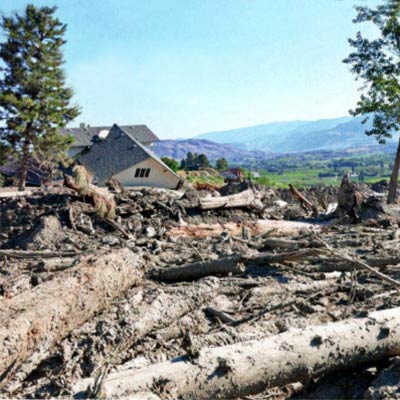
On a sunny afternoon in June 2010, my husband and I were working on our vineyard south of the town of Oliver in British Columbia’s Okanagan Valley when a torrent of mud and water blasted out of the hills We had little warning — the crack of cottonwoods and the clink of rocks crashing down the slope – before the creek that flows through our land became a roaring deluge that ripped through neighbouring houses, overturned trucks and left 16 hectares of vineyards and orchards buried in up to 1.5 metres of grey mud.

We had lived beside Testalinden Creek for nearly a decade with no inkling of the risk. In fact, we’d never even heard of debris flows before.

Debris flows are fast movements of water, soil, rocks and logs down steep creek channels. When soil becomes saturated with water, the slurry charges downstream, gathering logs, boulders and speed until it bursts out onto the flatter land below. Debris flows occur in mountainous areas around the world. They happen where they have happened before.

Fan-shaped land forms created by debris flows are common throughout the rugged southern B.C. Interior and are thought to have formed rapidly after glaciers melted around 10,000 years ago. People have been living on alluvial fans in the Okanagan for a century, even though the collision of geology, dam construction, slope side logging and a changing climate can be lethal. Nobody died last June, but debris flows have killed at least four people – and caused millions of dollars in damage – in British Columbia in the past decade.

Debris flows typically occur in the hot, dry Okanagan in spring or summer, seemingly out of the blue, according to Dwayne Tannant, an engineering professor at the University of British Columbia’s Okanagan campus and one of the organizers of the GeoHazards 5 conference held in Kelowna in May. “A common theme,” he says, “is rapidly warming temperatures and snowmelt in an upper watershed.”

That’s what happened west of our vineyard on Mount Kobau last June, when quickly melting snow filled a lake at the headwaters of Testalinden Creek and led to the failure of an old earthen dam. Other debris flows, including one in the nearby Similkameen Valley in 2004, have been caused by intense, localized rain storms. These convective storms, typical of arid regions, may be on the increase with climate change.

The Okanagan should develop a comprehensive landslide management plan, including maps of alluvial fans showing areas prone to the most destructive debris flows, says Kevin Turner, an engineer with Westrek Geotechnical Services Ltd. in Kamloops, B.C. “The science is there,” he says. “Climate change may increase the frequency of these events and the public will be able to convince the politicians to spend the money.”

A year has passed since a swath of our vineyard was buried in mud. We’ve dug ourselves out and replanted the grapes. But I can’t forget the words of the great American geology writer John McPhee, in his book The Control of Nature: Debris pours forth from the mountains continually, perennially, perpetually… [there’s] a great temporal disparity between the pace at which mountains behave and the way people think.”

Writing
All images by Darlene West
site design | ink.